Decoding India’s Tech Talent Market: A Segmentation Framework Every Global Leader Needs
April 2, 2026 • By Dheeraj Lalchandani

A practical guide for CTOs, CEOs, CHROs and Chiefs of Staff in the US, UK, UAE, Saudi Arabia and Australia who are building technology teams in India.
The Mental Model Mistake That Costs Millions
The single most expensive mistake a foreign leader makes when building an India tech team is not a process mistake or a compensation mistake. It is a mental model mistake.
They arrive with one true belief — "India has a massive, deep talent pool" — and one false assumption — that this pool is roughly uniform, and the differences are mostly about experience and salary negotiation.
They are right about the pool. They are dangerously wrong about the uniformity.
India's tech talent market is not a lake. It is five distinct rivers flowing in the same direction, at wildly different speeds, carrying fundamentally different water. A "Senior Software Engineer with 7 years of experience" can mean a person who could have been hired at Uber — and a person who has spent 7 years producing buggy code for a services firm that nobody held accountable for quality. Both exist. Both apply to the same job posting. Both quote salaries that look reasonable on a spreadsheet.
This framework is your map.
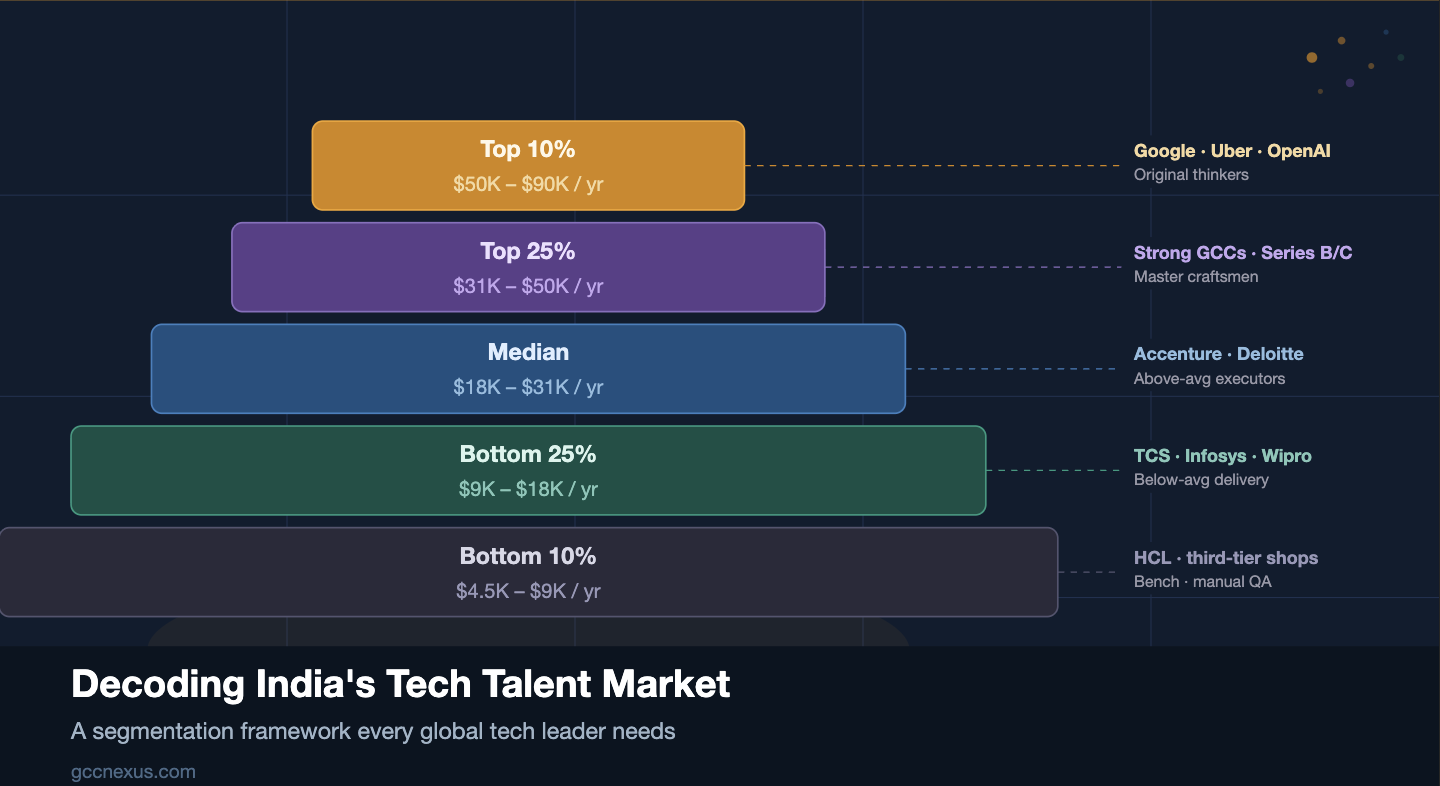
The Five Segments at a Glance
| Segment | Salary (USD/yr) | Salary (INR) | Profile |
|---|---|---|---|
| Top 10% | $50K–$90K | ₹45–80 LPA | Original thinkers. The Stanford equivalent of Indian engineering. |
| Top 25% | $31K–$50K | ₹28–45 LPA | Master craftsmen. Architect large systems. Execute brilliance. |
| Median | $18K–$31K | ₹16–28 LPA | Above-average executors. Deliver when the work is well-defined. |
| Bottom 25% | $9K–$18K | ₹8–16 LPA | Below average. Buggy work. Weak problem solving. |
| Bottom 10% | $4.5K–$9K | ₹4–8 LPA | The title says engineer. The capability does not. |
* All salaries are annual total compensation (CTC). Exchange rate: $1 = ₹90. Benchmarked for Bengaluru / Hyderabad, senior engineer profile, 6–9 years experience.
The Five Segments — In Depth
These are not just good engineers. They are a different kind of mind.
They come overwhelmingly from India's elite institutions — the IITs, top NITs, BITS Pilani, IIIT Hyderabad — where admission to Computer Science requires clearing the JEE Advanced in the top 1–2% of over a million applicants. That filter concentrates a specific type of person: someone who learned to solve problems they had never seen before, under pressure, with no template to follow.
They have spent their careers at companies where that ability matters commercially — Google, Microsoft, Uber, OpenAI (India teams), Flipkart, Razorpay, Swiggy, Zepto, and the top tier of India's unicorn ecosystem.
What distinguishes this segment is not their technical knowledge — though it is deep — but their orientation toward problems. They do not wait to be told what to build. They question whether the right thing is being built. They are, in the truest sense, the Stanford or MIT equivalent of Indian engineering talent.
If Segment 1 are the inventors, this segment are the master builders — and for most companies building India teams, they are the most important hire you will make.
These engineers are genuinely excellent. They can design and architect large, complex systems. They write clean, maintainable code. They lead technical decisions, run meaningful code reviews, and mentor junior engineers effectively.
They are typically found at strong GCCs, well-funded Series B and C startups, and MNC R&D centres — companies that set and enforce a meaningful engineering bar.
This is the largest segment, the most commonly encountered in hiring pipelines, and the most consistently misread by foreign leaders.
These engineers are genuinely above average — they can write working software, understand their domain, and troubleshoot within familiar territory. In the right environment — a structured team with clear technical leadership and well-defined work — they deliver real value.
But they have a ceiling. They lack the precision and depth that fault-tolerant, complex system design requires. Their primary environments are Accenture, Deloitte, and the consulting firm tier, along with smaller startups. Importantly, this segment represents the premium talent inside TCS, Infosys, and Wipro.
These engineers are below average, and the market knows it. The salary range reflects a genuine quality signal — not just cost-of-living adjustment, but a lower baseline of problem-solving ability and technical depth.
They come predominantly from Tier-3 and below engineering colleges and have spent their careers in environments that did not demand rigour — small outsourcing firms, regional IT companies, the bench-heavy volume hiring model of India's large services companies.
These individuals hold engineering degrees and carry long CVs listing technologies they have "worked with." The honest assessment: the engineering title does not reflect engineering capability. There is no analytical foundation — no instinct for problem decomposition, no ability to reason through an unfamiliar problem.
The Three Things That Actually Tell You Which Segment You're Hiring
Titles are useless. Years of experience are misleading. Even salary history can be gamed. Three signals actually work.
What This Means for Your Hiring Strategy
The talent pool is real. The depth is real. India genuinely has more top-tier engineering talent per dollar than any other market in the world at scale.
But the diversity within that pool is also real — and most foreign companies discover it the hard way, 18 months into a hiring programme that targeted the wrong segment, with a team that is underperforming relative to expectations and no clear understanding of why.
The framework above is not a reason to be pessimistic about India hiring. It is a reason to be precise about it. Decide which segment your work requires. Design a hiring process that actually identifies that segment. Build a team structure and management environment that can attract and retain it.
The companies that do this well build India teams that become genuine competitive advantages. The companies that don't will spend years explaining to their boards why the cost savings weren't what the spreadsheet promised — and they will be right, for entirely the wrong reasons.
GCC Nexus helps startups and scaleups from the US, UK, UAE, Saudi Arabia and Australia build the right India team from day one. Visit gccnexus.com to explore salary benchmarks, city guides, and expert advisory.