How to Choose an India Team Partner: 8 Checks
November 25, 2026 • By Dheeraj Lalchandani
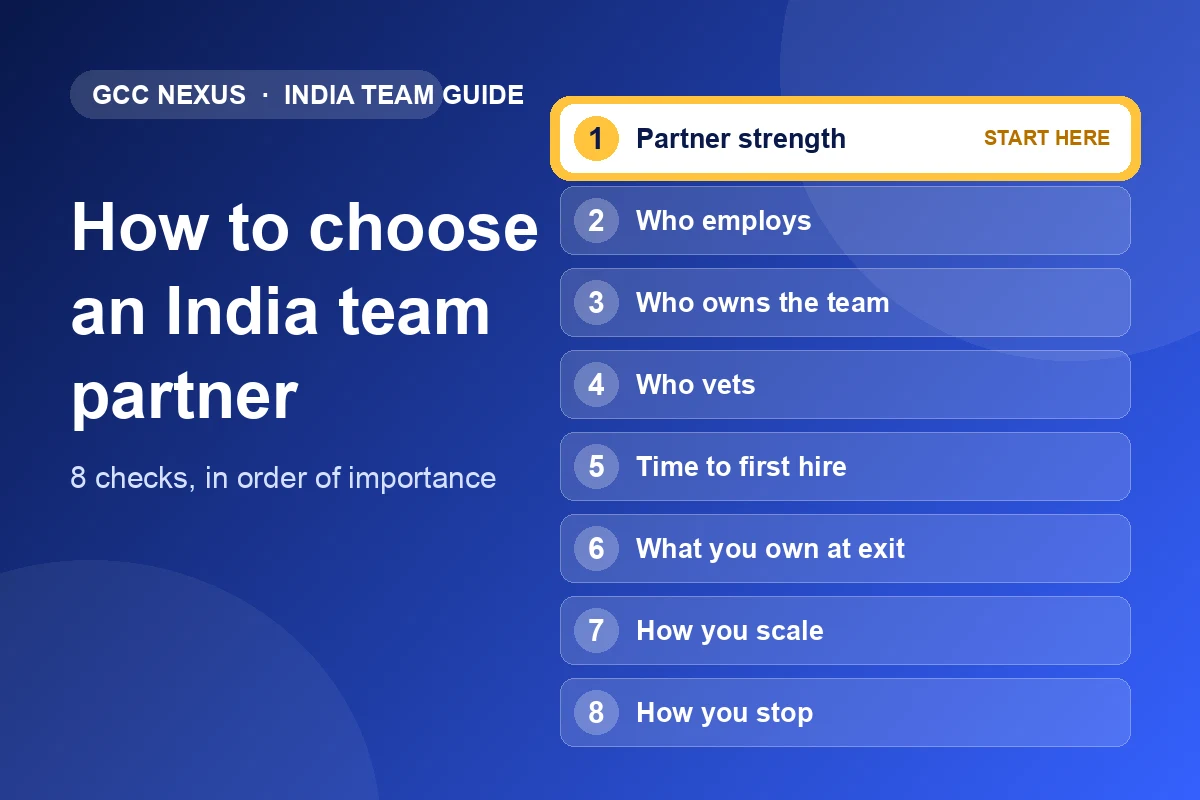
Choose an India team partner by first checking how strong it is at hiring top engineers. Then check who employs them, who owns your team and how you leave.
Written by Dheeraj Lalchandani. Last updated: November 2026.
The quality of your team is decided by the partner you pick. So the first check is the one that matters most: how strong the partner is, technically and in experience, and how well its AI-enabled sourcing reaches top engineers who are not looking. Seven more checks follow: who employs the engineers, who owns the team, who vets candidates, how fast the first engineer starts, what you own at exit, how the team scales and how you stop. Ask for each answer in writing. GCC Nexus's own answers are in the table below.
| Question | GCC Nexus answer |
|---|---|
| Sourcing | TalentRadar, GCC Nexus's AI outbound platform, finds engineers who aren't looking. No job ads. |
| Talent pool | Top 1% engineers, sourced by company pedigree from India's best product companies |
| Vetting | 7-step technical and cultural vetting; candidates are interviewed by independent domain experts before you see them |
| Shortlist | 5 vetted profiles in 7 days |
| First engineer | Live in about 2 weeks |
| Legal employer | GCC Nexus, in the managed-team model |
| Who owns the team | You |
This guide is for founders, CTOs, VPs of Engineering and COOs who have decided to build in India and are now comparing providers. A GCC (Global Capability Center) is a company's own engineering center in India. You can reach one by building it alone, through an agency, or through a managed team. The checks work for all three.
The short version: 8 checks at a glance
Score each provider 0 to 2 on every check: 0 for a warning sign, 1 for a partial answer, 2 for a good answer. The scoring is GCC Nexus's view of good practice, and check 1 matters most because it decides the quality of every engineer you meet. It gives you a fair way to compare answers instead of comparing sales decks.
| # | Check | Ask the provider | A good answer sounds like | Warning sign |
|---|---|---|---|---|
| 1 | How strong the partner is | "How do you find and judge top engineers, and what teams have you built?" | Technical experts judge candidates; AI-enabled outbound sourcing at product companies; named teams you can verify | Job-board reposts, a bench of unassigned staff, recruiter-only screening, no verifiable team |
| 2 | Who employs the engineers | "Whose payroll are they on, and who is the legal employer?" | A named employing entity and a model you can explain to your board | "They work for us, for you" |
| 3 | Who owns the team | "If the contract ended, whose team is it?" | The team is yours, and the agreement says so in writing | The provider keeps the people and rotates them |
| 4 | Who vets | "Who interviews, and do I see only those who passed?" | Independent technical experts interview before you see anyone | Recruiter-only screening, or you do all the screening |
| 5 | Time to first engineer | "How long to a shortlist, and to the first start?" | Two specific timings, backed by a named example | A loose range with no example, or "full team in weeks" |
| 6 | What you own at exit | "What transfers to me, and how?" | Written transfer terms for the entity, the people and the code | "We will discuss it later" |
| 7 | How you scale | "Show me a team that grew well beyond its first hires." | A real case with a headcount | Only small pilots, or large-enterprise logos |
| 8 | How you stop | "How do I reduce or end the team?" | Notice and wind-down terms stated plainly | A long lock-in buried in the contract |
Three ways to build an India team
Most of the confusion in provider calls comes from mixing up three different operating models. Work out which one you are buying before you compare prices or promises.
| In-house (your own entity and hiring) | Agency-run (the provider employs and manages the people) | Managed team you own (GCC Nexus model) | |
|---|---|---|---|
| Who employs the engineers | You, through your own India entity | The provider | GCC Nexus is the legal employer in the managed-team model |
| Who owns the team | You | Usually the provider | You |
| Who finds and vets talent | You | The provider | TalentRadar outbound sourcing; interviewed by independent domain experts before you see them |
| Who runs office, payroll and compliance | You | The provider | GCC Nexus handles employment, payroll, compliance, office and equipment |
| Best fit | Companies ready to run an entity and HR in India | Short projects and capacity top-ups | Companies building a lasting engineering team |
In-house gives you the most control and asks the most of your own time. Agency-run is quick to start and suits work with an end date. A managed team sits between them: someone else carries the setup and the HR load, while the team stays yours. For a fuller comparison, read GCC vs outsourcing.
The 8 checks, one by one
1. How strong is the partner at finding and hiring top engineers?
Everything else on this list depends on this check. A partner can employ people correctly and hand over the team on time and still give you average engineers. The quality of your team comes from three things: the partner's technical depth, its track record building teams like yours, and how well it reaches engineers who are not looking for a job.
Ask: "Who judges candidates technically, how do you find engineers who are not applying, and which teams have you built that I can check?"
Good answer: Technical experts, not only recruiters, judge the candidates. Outreach goes direct to engineers at product companies, with AI helping to find them. The teams are real and you can verify them. GCC Nexus uses TalentRadar, its AI outbound platform, to find engineers who aren't looking, with no job ads. It sources top 1% engineers by company pedigree from India's best product companies, such as Razorpay, Swiggy, CRED and Google India. Independent domain experts interview each candidate before you see them, and the vetting covers technical and cultural fit. The teams behind Barq, Shopping Gate and Advanced Infrastructure are in the table below.
Warning sign: Reposted job ads, a bench of people waiting to be assigned, recruiter-only screening, and no team you can verify.
2. Who employs the engineers?
Employment decides who carries the legal and payroll obligations in India, and who the engineer answers to when your priorities and the provider's collide. If the answer is fuzzy, the rest of the contract will be fuzzy too.
Ask: "Whose payroll are they on, and who is the legal employer?"
Good answer: A named entity, and a plain description of how it works. In GCC Nexus's managed-team model, GCC Nexus is the legal employer and the engineers work for your team.
Warning sign: An answer that avoids the word "employer" and says something like "they work for us, for you."
3. Who owns the team and the work?
A team you do not own is capacity you rent. Rented capacity can be reassigned the day a bigger client calls. Ownership shows up in small things: who approves a hire, who sets priorities, and who an engineer reports to.
Ask: "If the contract ended, whose team is it?"
Good answer: "Yours," with the agreement saying so. With GCC Nexus, the team is yours.
Warning sign: The provider keeps the people and moves them between accounts.
4. Who vets candidates, and before you see them?
You can spend a month interviewing people a provider should have screened out. The point of vetting is to protect your senior engineers' time. Who does the interview matters as much as whether there is one.
Ask: "Who interviews candidates, and do I only see the ones who passed?"
Good answer: Independent technical experts run the interview and you see only people who cleared it. At GCC Nexus, candidates are interviewed by independent domain experts before you see them, and the vetting covers both technical and cultural fit.
Warning sign: Recruiter-only screening, or a process where your team does the filtering.
5. How long until the first engineer starts?
Speed claims are easy to make and hard to compare. Ask for two timings, not one: time to a shortlist and time to a first start. Then ask for a real example of each.
Ask: "How long to a shortlist, and how long to the first engineer starting?"
Good answer: Two specific timings and a named case. GCC Nexus's timings are in the table in the next section, and Shopping Gate is the example, with its early hires shown in the practice table.
Warning sign: A wide range with no example, or a promise of a full team in a matter of weeks. A first engineer and a full team are different milestones, and a provider that blurs them is hiding the second one.
6. What do you own if you leave?
Exit terms are easiest to negotiate before you have people on the ground. After that, the provider holds the leverage. Get the answer while you still have choices.
Ask: "What transfers to me if I leave, and how?"
Good answer: Written terms covering the entity, the people and the code, in plain language.
Warning sign: "We can discuss that later."
7. How does the team scale from 10 to 100?
Many providers can place three engineers. Fewer have grown a team through the stage where hiring, management layers and office space all become real problems. Ask to see one that did.
Ask: "Show me a team that grew well beyond its first hires, with a headcount."
Good answer: A real case with a number you can verify. GCC Nexus's examples are in the practice table below.
Warning sign: Only small pilots, or logos from large enterprises that have no bearing on a mid-size team.
8. How do you stop or change course?
Your plans will change. Funding shifts, a product is cut, a market opens. A good provider tells you how to shrink or end the team without surprises, and says it before you sign.
Ask: "How do I reduce or end the team, and what notice applies?"
Good answer: Notice and wind-down terms stated plainly, in the contract and in conversation.
Warning sign: A long lock-in buried in the small print.
What this looks like in practice
The table below holds the figures that matter for checks 5 and 7. They come from GCC Nexus's own client work. The Barq case shows a team that grew far past its first hires, and the Shopping Gate case shows how early the first engineers can start. Read the full Barq case study for how that team was built.
| Item | Figure | Source |
|---|---|---|
| Shortlist | 5 vetted profiles in 7 days | GCC Nexus process |
| First engineer | Live in about 2 weeks | GCC Nexus process |
| Barq | 100+ engineers today; first 10 hires in 8 weeks | Barq case study |
| Shopping Gate | First 2 hires within 2 weeks; a cross-functional team of 15 operational within 3 months | Shopping Gate case study |
| Advanced Infrastructure | Started with one data engineer; the team now stands at 24 engineers | Advanced Infrastructure case study |
Advanced Infrastructure started with one data engineer in India. It then built up its backend, DevOps and frontend teams there. Starting small and adding functions as the work grows is a common path.
Questions to ask before you sign
Copy this list into your next provider call. Ask for written answers.
- Who judges candidates technically, and how do you find engineers who are not applying?
- Who is the legal employer of the engineers, and which entity is it?
- If the contract ended, whose team is it?
- Who interviews candidates, and do I only see those who passed?
- How long to a shortlist, and how long to the first engineer starting?
- Which real client started small and grew? What is its headcount now?
- What transfers to me if I leave: the entity, the people, the code?
- How do I reduce or end the team, and what notice applies?
- Who handles payroll, compliance, office and equipment?
- Can the engineers work only for my company?
Who this is for, and who it is not for
This approach fits mid-size product companies building a lasting India team, from the first engineer up to a large team. It suits you if you want your own team, your own priorities and an engineer who stays.
GCC Nexus is not the right choice for short tasks that end in weeks, or for a decision made on price per hour. It is also not the right choice if you want someone else to deliver a fixed-scope project end to end. For those, an agency-run model is the better match. The comparison is in GCC vs outsourcing.
FAQ: choosing an India team partner
How do I choose a partner to build an engineering team in India?
Compare providers on eight checks, starting with how strong the partner is at finding and hiring top engineers: technical depth, track record and AI-enabled sourcing. Then check who employs the engineers, who owns the team, who vets candidates, how fast the first engineer starts, what you own at exit, how the team scales and how you stop. Ask for written answers and score each one. A partner who answers all eight plainly is easier to trust than one who leads with a price.
What should I ask an India team provider before signing?
Ask how it finds and judges engineers, who the legal employer is, whose team it is if the contract ends, who interviews candidates and what transfers if you leave. Then ask for a real client that grew from a small start. The list in this guide has ten questions you can copy.
Who is the legal employer of the engineers in a managed-team model?
In GCC Nexus's managed-team model, GCC Nexus is the legal employer of the engineers. GCC Nexus handles employment, payroll, compliance, office and equipment, and the team is yours.
How fast can a provider start an engineer in India?
With GCC Nexus, a shortlist of 5 vetted profiles arrives in 7 days, and the first engineer is live in about 2 weeks. A full team takes longer. The table above shows how the Barq, Shopping Gate and Advanced Infrastructure teams grew.
Is a managed team different from outsourcing?
Yes. In outsourcing, the provider keeps the people and the work is delivered to you. In a managed team, GCC Nexus finds and vets the engineers and handles the employment and office side, and the team is yours. Read GCC vs outsourcing for the full comparison.
How big does a team need to be before this model makes sense?
In GCC Nexus's view, a managed team suits companies building a lasting engineering team, from one engineer up to a large team. The Barq, Shopping Gate and Advanced Infrastructure teams in the table above each started small and grew.
Next step
If your answers point to a team you own, tell us the roles you need and we will send a shortlist of vetted profiles. For the service itself, see GCC setup in India.