Four ways to hire developers in India
Most pages on this topic sell you one of these routes. Here are all four, side by side.
| Freelancer or contractor | Employer of record (EOR) | Staffing firm or agency | Your own team with GCC Nexus | |
|---|---|---|---|---|
| Who employs the engineer | The engineer, self-employed | The EOR is the legal employer; you direct the daily work | The firm | Your team. GCC Nexus handles entity, payroll, compliance, office and equipment |
| Who owns the code and the team | You own the code only if the contract assigns it in writing | You direct the work; the contract sits with the EOR | The firm holds the relationship with the engineer | You own the team |
| What you pay on top of salary | Nothing, but you get no payroll or benefits cover | A monthly fee per person | The firm's margin, folded into an hourly or monthly rate | A fee for running the setup (ask us for the structure) |
| Main risk | A full-time contractor can be treated as an employee; they can also leave with a day's notice | Fees grow with headcount; you still find and vet the person | Engineers can be swapped; you may never meet who writes your code | A longer commitment than a contractor |
| Fits best | A task of a few weeks, a prototype, a specialist for a gap | One or two hires you have already found | A fixed-scope project someone else delivers | A team you plan to keep and grow |
The cheapest route for the first month is rarely the cheapest for the first year. If you will hire three or more engineers in the next twelve months, or the work sits at the centre of your product, start with your own team. If you have a clear task that ends, use a freelancer.
Contract, employment and tax terms vary by case. Take advice from a lawyer in the country where you hire before you sign.
How hiring developers in India works with GCC Nexus
- You send a brief: role, stack, seniority, the hours you need overlap, and the problem the engineer will own.
- TalentRadar, GCC Nexus's AI outbound platform, finds engineers who aren't looking. No job ads. We source top 1% engineers by company pedigree from India's best product companies, such as Razorpay, Swiggy, CRED and Google India.
- Independent domain experts interview the candidates first, and each goes through our 7-step technical and cultural vetting before you see a profile. You receive a shortlist of 5 vetted profiles in 7 days.
- You interview the candidates and make the choice.
- Your first engineer goes live in about 2 weeks. We handle the entity, payroll, compliance, office and equipment. A team of 5 to 10 engineers is typically fully onboarded within 6 to 8 weeks from the first hire going live.
Engineers at product companies are usually employed, so the notice period at their current employer can add time.
What it costs to hire a developer in India
Search for a "senior developer in India" and the annual prices differ by four times or more. The pages are not wrong. They measure different things.
| Page and date | What the number is | Senior figure |
|---|---|---|
| Contra (2026) | Annual salary, 5+ years | INR 15 to 30 lakh, about $18,000 to $36,000 a year |
| Wisemonk (updated 15 Sep 2026) | Annual salary, senior .NET, 6 to 8 years, at INR 95 = $1 | INR 15 to 25 lakh, about $15,800 to $26,300 a year, before any EOR fee |
| Witarist (7 Jun 2026) | An hourly rate from a staffing firm, Java, 6 to 9 years | $45 to $60 an hour, or $7,200 to $9,600 for 160 hours a month. Over a year that is about $86,400 to $115,200 (our arithmetic) |
A salary, an employer cost and a staffing rate are three different numbers. A staffing rate includes the firm's margin and overhead. Compare like with like or the saving you compute will be wrong.
Here are ours. They are annual salary in USD for the India top 10% band at 6 years of experience, against the equivalent US salary (GCC Nexus 2026 data):
| Role | India (top 10%, 6 years) | US equivalent | Saving |
|---|---|---|---|
| Python developer | $66,500 | $135,000 | 51% |
| ML engineer | $69,600 | $190,000 | 63% |
| AI engineer | $69,600 | $220,000 | 68% |
| DevOps / SRE | $54,100 | $130,000 | 58% |
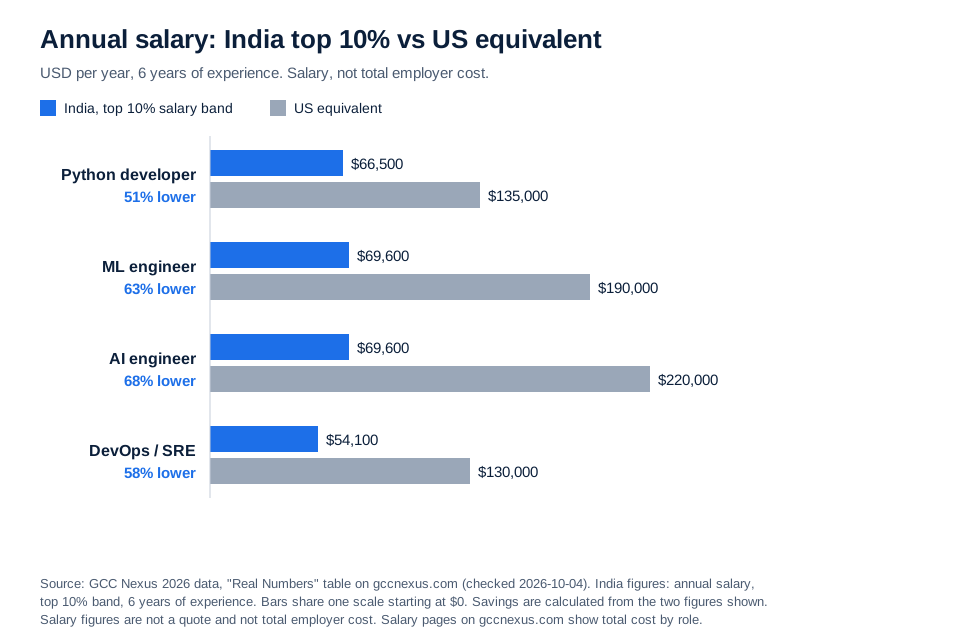
These are salary figures, not total employer cost and not a quote. Our band is higher than the broad "senior" averages above because it describes the top 10% of pay at 6 years, not the average senior. "Top 10%" is the salary band; "top 1%" describes where we source, by company pedigree. They are different measures. Total employer cost by role is on each salary page, and the method sits behind our India salary benchmark, built from 100,000+ salary profiles.
Across our client work we see about a 50% cost saving against US and UK rates. For a market-by-market view, see the US, UK, Australia and UAE cost comparisons.
Developers you can hire
Start from the role. Each page has the salary data and how we hire for it.
- Python developers: back ends, data pipelines, APIs.
- AI engineers: LLM features and applied AI in your product.
- Machine learning engineers: models in production.
- React developers: front ends for web products.
- Java developers: enterprise and high-volume back ends.
- DevOps engineers: cloud, pipelines and reliability.
Looking for data engineers, full stack developers or another role? The hub for engineers in India lists every role and the dedicated-team model.
From one engineer to a team
Teams we have built, and how fast the first hires started:
| Client | What happened |
|---|---|
| Shopping Gate (Saudi Arabia) | First 2 hires within 2 weeks; a full cross-functional team of 15 operational within 3 months |
| Pulse Energy | Full engineering team operational in 9 weeks |
| Airrived | Full engineering team operational in 7 weeks |
| Fincobox (UAE) | 10+ engineers; first hires in 6 weeks |
| Advanced Infrastructure (UK) | 24 engineers from IIT, BITS and IIIT |
| Barq (Saudi Arabia) | 100+ engineers today; first 10 hires in 8 weeks; 50% cost saving |
Advanced Infrastructure started with one data engineer in India. It then built up its backend, DevOps and frontend teams there, and the team now stands at 24 engineers.
When the plan moves from "a team" to "a development centre" with its own entity and office, read the GCC setup guide for India and the offshore team page.
If you are in the US, UK, Australia or the UAE
United States. India Standard Time is UTC+5:30 and has no daylight saving. That puts India 9.5 hours ahead of US Eastern in summer and 10.5 in winter, and 12.5 or 13.5 ahead of US Pacific. The overlap is the end of the Indian day and the start of yours: an engineer who works until 8pm IST is online until 10:30am US Eastern in summer. Agree the hours before the offer. The salary comparison above is the US case: $66,500 against $135,000 for a Python developer.
United Kingdom. India is 4.5 hours ahead of London in summer and 5.5 in winter. An engineer on a 10:00 to 19:00 IST day overlaps your morning and early afternoon, until 14:30 in summer and 13:30 in winter (our arithmetic from the UTC offsets). For local pay, one 2026 salary summary puts mid-level software engineers in London at £70,000 to £100,000 base (Sponsio, indicative). Compare our India figures at today's exchange rate, not a quoted one. Many UK buyers ask about IR35, the UK off-payroll tax rules for contractors. Those rules aim at contractors who are in the UK tax net. A tax adviser site notes that a non-UK-resident contractor working wholly outside the UK for a UK client is often outside the charge (IR35 Update), but it depends on the facts, so ask your adviser. The risk that matters more on an India hire is Indian: a full-time "contractor" who works like an employee. We built a UK team of 24 engineers for Advanced Infrastructure.
Australia. India is 4.5 hours behind Sydney in winter (AEST) and 5.5 hours behind in summer (AEDT). On a standard 10:00 to 19:00 IST day, the overlap with a 9 to 5 Sydney office is about 2.5 hours in AEST and 1.5 in AEDT, so Australian teams usually ask for an earlier start. Settle this before the offer. For local pay, a Sydney recruiter puts senior software engineers at AUD 160,000 to 190,000 base and mid-level at AUD 120,000 to 160,000, from accepted offers in the 12 months to mid-2026 (Re:Sourced). Australian employers also pay superannuation of 12% on top of salary since 1 July 2025 (Xero guide to the Super Guarantee changes). Convert our India salary at today's rate and add your own on-costs to compare.
United Arab Emirates. The UAE is 1.5 hours behind India, so your working days almost fully overlap. The UAE has no personal income tax on salaries (Expat Wealth Plus; Federal Decree-Law No. 47 of 2022), so local pay is quoted tax-free; compare on salary, not on take-home.
If your UAE company sits in DIFC or ADGM, those zones run their own employment law for UAE staff (Datassist); that is a separate question from employing an engineer in India. We built a 10+ engineer team for Fincobox.
Why your own team instead of a vendor
You meet each engineer before you commit, and the person you interviewed is the person who does the work. They join your backlog, your standup and your code reviews, so you are not managing a second company. And the team is yours, so you can keep adding to it without a handover or a rebuild.
When GCC Nexus is not the right fit
We would rather you know now. Look elsewhere if:
- the work ends in a few weeks. A freelancer or contractor is cheaper and faster for a bounded task.
- price per hour decides it. We source engineers from India's best product companies, so a marketplace or a low-cost agency will usually quote less.
- you want someone else to deliver a fixed-scope project. That is an agency job. We build your team, which works in your process, so someone on your side has to set priorities and review the work.
Questions about hiring developers in India
How do I hire a developer in India, and how long does it take?
Choose a route (contractor, employer of record, agency or your own team), then source, interview and onboard. With GCC Nexus you receive a shortlist of 5 vetted profiles in 7 days and your first engineer is live in about 2 weeks. A team of 5 to 10 engineers is typically fully onboarded within 6 to 8 weeks from the first hire going live.
How much does it cost to hire a developer in India compared with the US, UK, Australia or the UAE?
For a Python developer in the India top 10% band at 6 years, the salary is $66,500 against $135,000 in the US, a 51% saving (GCC Nexus 2026 data, annual salary, not total employer cost). UK, Australian and UAE comparisons are in the market section above and on our cost comparison pages. Check which basis any figure uses: salary, employer cost or a staffing rate.
Can I hire a developer in India without my own Indian company?
Usually yes. The two common routes are an employer of record, which employs the person for you, or a setup built for you, where GCC Nexus handles entity, payroll, compliance, office and equipment. Paying a full-time engineer as a contractor is the route most likely to cause trouble. Take legal advice for your case.
Contractor or employee: what is the risk?
If someone works full time, on your schedule, on your tools, they may be treated as an employee whatever the contract says. That can bring back pay, fines and other claims. Contractors fit work that is scoped and ends. This is general information, not legal advice.
How do you vet developers?
Candidates are interviewed by independent domain experts before you see a profile, and they go through a 7-step technical and cultural vetting. We source top 1% engineers by company pedigree from India's best product companies, such as Razorpay, Swiggy, CRED and Google India. You then run your own interview.
Who owns the code and the team?
You own the team. For the code, put an explicit written assignment of IP in every contract, whichever route you pick; a contractor does not necessarily hand over rights by default. Have a lawyer check the wording.
Can I start with one engineer and scale?
Yes. The case studies above show first hires in 2 to 8 weeks and teams that grew to 15, 24 and 100+ engineers. Tell us the role and the size you expect in a year, and we will say which route fits.
What time-zone overlap will I have?
It depends on where you are. The UAE overlaps almost fully. The UK overlaps through the morning and early afternoon. The US overlaps at the start of your day. Australia needs an earlier start from the engineer. Details are in the market section above.