How Long to Build an India Engineering Team
November 26, 2026 • By Dheeraj Lalchandani
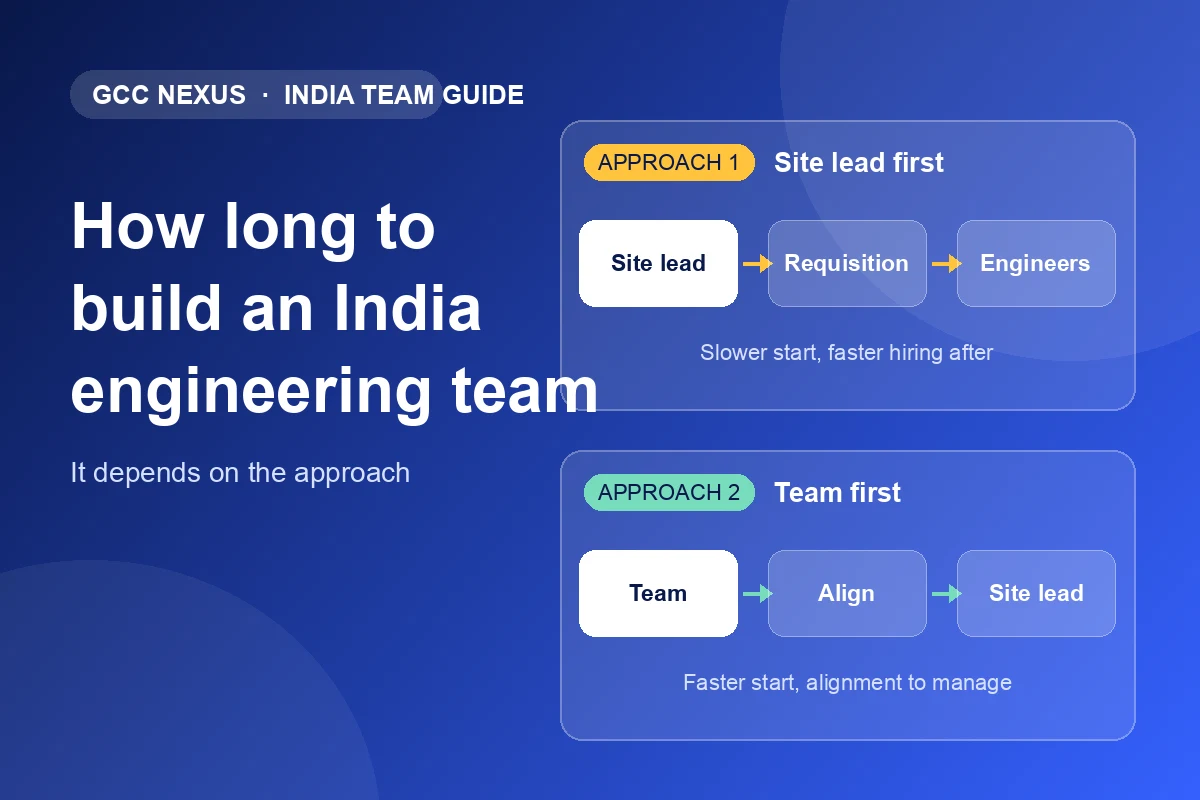
How long an India team takes depends on how you build it. Hire a site lead first and the start is slower. Build the team first and it runs faster at first.
Both approaches work. This guide sets out each one, what slows it down, and the timings GCC Nexus clients have hit. For the engineers themselves, a shortlist of 5 vetted profiles arrives in 7 days and the first engineer is live in about 2 weeks.
Written by Dheeraj Lalchandani. Last updated: November 2026.
Two ways to build an India team
Every India build starts with one choice: who do you hire first? The answer sets the pace for everything that follows.
The two approaches side by side.
| Approach 1: site lead first | Approach 2: team first | |
|---|---|---|
| First hire | An India site lead, your point of contact at headquarters | The engineers, product managers and QA you plan for |
| Who plans the team | You and the site lead, together | You, from headquarters |
| Slowest step | Finding the site lead | Aligning and motivating the team on one goal |
| Pace of the first hires | Slower | Faster |
| Pace after the lead is in place | Faster | Steady, then a site lead takes over the team later |
| Best when | You want a leader in India who owns the goals from the start | You know the team you need and want people working sooner |
Approach 1: hire an India site lead first
Your first hire is a site lead in India. This person is your point of contact for headquarters and runs the build with you.
- Hire the site lead. This is the slowest step, because a senior leader who fits your goals is harder to find than an engineer. It sets the pace for the whole build.
- Set priorities together. You spend time with the site lead and agree the objectives of the India team.
- Get a requisition. The site lead comes back with how many people you need, in which designations and at which levels.
- Hire the engineers. This stage is faster. The site lead tells candidates the objectives and what is expected of them, so the right people say yes.
The benefit is alignment. The people who join already know the goal, and they report to a leader who sits with them every day. The cost is the time to find that leader before the team starts to grow.
Approach 2: decide the team at headquarters and hire first
In the second approach you set the focus and objectives of the India team yourself, from headquarters.
- Decide the objective. Settle what the India team is there to do.
- Work out the team. Count the engineers, product managers and QA engineers you need.
- Start hiring. The team forms quickly because you are not waiting on a leader.
- Hire a site lead later. Once the team is working, you appoint an India site lead and hand the team over.
The benefit is speed: people are working sooner. The trade-off is alignment. A team with no leader on site needs more of your attention to stay motivated and pointed at a common goal, until the site lead takes over.
Which approach fits you?
Pick by what matters most in the first quarter.
| If this is true for you | Lean towards |
|---|---|
| You want a leader in India who owns the goals from day one | Approach 1: site lead first |
| You want to attract senior engineers with a clear story from a local leader | Approach 1: site lead first |
| You already know the roles and numbers you need | Approach 2: team first |
| You can give the team daily direction from headquarters for a while | Approach 2: team first |
| People working on your roadmap soon matters most | Approach 2: team first |
Many companies start with approach 2 and add the site lead after the first group is working. Others begin with the lead. Both routes end in the same place: a site lead running a team that is aligned to your goals.
What GCC Nexus does in each approach
The hiring engine is the same in both. TalentRadar, GCC Nexus's AI outbound platform, finds engineers who aren't looking. No job ads. We source by company pedigree from India's best product companies, such as Razorpay, Swiggy, CRED and Google India. Independent domain experts interview candidates before you see them, through a 7-step technical and cultural vetting.
What GCC Nexus handles at each stage.
| Stage | Timing |
|---|---|
| Shortlist of 5 vetted profiles | 7 days |
| First engineer live | About 2 weeks |
| Team of 5 to 10 engineers fully onboarded | 6 to 8 weeks from the first hire going live (how a GCC setup works in India) |
"Live" means the engineer has started working on your product. In approach 1, GCC Nexus finds and vets the senior site lead search first, then the engineers the site lead requisitions. In approach 2, GCC Nexus goes straight to the engineers, product managers and QA you listed. GCC Nexus is the legal employer and handles payroll, compliance, office and equipment, so no entity of your own is needed to start. Your team owns the work and direction.
Timelines from real teams
These are the timings our clients' teams hit. The companies are different sizes with different goals, so read each row on its own.
Build timelines from four GCC Nexus clients.
| Team | What was built | Timing |
|---|---|---|
| Barq | 100+ engineers today | First 10 hires in 8 weeks |
| Shopping Gate | A full cross-functional team of 15 | First 2 hires within 2 weeks; 15 operational within 3 months |
| Fincobox | 10+ engineers | First hires in 6 weeks |
| Advanced Infrastructure | 24 engineers | Started with one data engineer, then added backend, DevOps and frontend teams |
Advanced Infrastructure started with one data engineer in India. It then built up its backend, DevOps and frontend teams there, and the team now stands at 24 engineers.
Shopping Gate is the row to remember when you plan. The first two engineers started within 2 weeks. The full cross-functional team took until month three, because it needs several different roles.
Why some teams take weeks and others take months
Beyond the approach you pick, five things decide the pace. This is GCC Nexus's view, drawn from how builds differ.
- Team size. Ten hires take longer than two, because every hire needs a shortlist, interviews and a decision.
- Number of different roles. Five backend engineers are faster to build than a team that needs backend, DevOps, frontend, data and a lead.
- Seniority mix. Senior engineers who have built large systems at product companies are fewer, so the search is more selective. Junior roles move faster.
- Your decision speed. Fast feedback keeps a build moving, so book interview slots before the shortlist lands.
- Your own Indian entity. If you set up a company yourself, hiring waits for it. With the managed route, hiring starts first. Read the build-operate-transfer page if you want your own company in the end: it is the quickest way to own an Indian company that is already running your team.
How to plan your own timeline
Use this list before you brief us or anyone else.
- Choose your approach. Site lead first, or team first. Decide this before anything else, because it sets the order of every hire.
- Write down the objective. One paragraph on what the India team is for. A site lead will use it to brief candidates. A team-first build uses it to keep everyone aligned.
- Rank your roles. Decide which engineer or lead you need first, and which roles can wait for a second wave.
- Name your interviewers. Pick the two people who will interview and agree to give feedback within a day or two.
- Define the first task. The engineer should have a real ticket waiting on day one, not an onboarding doc.
- Plan hires in waves. Shopping Gate and Advanced Infrastructure both grew in stages.
Salary and cost figures live on the India salary benchmark. Teams hired through GCC Nexus save about 50% against US and UK rates, with engineers who have built large-scale systems at product companies.
FAQ: how long it takes to build an engineering team in India
How long does it take to build an engineering team in India?
It depends on your approach. If you hire an India site lead first, the start is slower and the hiring that follows is faster. If you hire the team first, people are working sooner and you appoint a site lead later. With GCC Nexus, your first engineer is live in about 2 weeks.
Should I hire an India site lead first?
Hire the site lead first if you want a leader in India who owns the goals and speaks to candidates from day one. Expect the search for that leader to be the slowest step. If you want people working sooner, hire the team first and add the site lead later.
What does an India site lead do?
The site lead is your point of contact for headquarters. You define priorities and objectives together, and the site lead returns with a requisition: how many people, in which designations and at which levels. The site lead also tells candidates the objectives and what is expected of them.
How fast can I get my first engineer in India?
With GCC Nexus you receive a shortlist of 5 vetted profiles in 7 days, and your first engineer is live in about 2 weeks. The profiles come from TalentRadar and are interviewed by independent domain experts before you see them.
How long until a team of 10 is working?
Barq reached its first 10 hires in 8 weeks. For a team of 5 to 10 engineers, onboarding is typically complete within 6 to 8 weeks from the first hire going live. The two figures measure different things: one is a client's hire count, the other is a typical onboarding window after the first engineer is live.
Can I have a full team in 2 weeks?
No. The first engineer is live in about 2 weeks. Shopping Gate's first 2 hires started within 2 weeks, and its full team of 15 was operational within 3 months. Plan your build in waves.
Do I need my own Indian company before I can start?
No. In the managed model GCC Nexus is the legal employer of your engineers, so hiring starts without an entity of your own. If you want your own company later, see how a GCC setup works in India. For pay levels, see the India salary benchmark.
Start with a shortlist
The quickest way to see your own timeline is to look at real profiles. Get a shortlist of 5 vetted profiles in 7 days, or read how a GCC setup works in India if you are planning a full development center. When you are ready to talk roles, tell us the team you need.